

Debates about youth well-being often assume that the newest technology is responsible for rising distress. In the current discussion, smartphones and social media receive most of the attention. Restrictions on screen time are frequently proposed as the remedy.
The previous essay examined this question using recent Monitoring the Future data and found little evidence that screen-time limits reliably improve happiness on their own. The results suggested a different explanation. Positive outcomes associated with screen-time limits often reflect underlying family dynamics rather than the limits themselves. Heavy technology use often functions as a compensatory behavior that emerges when material and psychological needs are not consistently met.
If that interpretation is correct, the same pattern should appear in earlier eras when different technologies occupied young people’s attention. Television was the dominant screen medium during the early 1990s. Parents frequently worried about excessive viewing and imposed limits on it. If the compensatory-use model is correct, those limits should display the same conditional pattern observed in modern screen-time debates.
Monitoring the Future allows this historical test. The survey began asking about parent-child communication in 1992. The analysis therefore focuses on 1992 through 1995, a period just before the internet became a meaningful part of young people’s daily media environment.
The figures below examine girls in grades 8 and 10 during those four years, using the same variables as the previous analysis but focusing on television rather than social media to allow direct comparison.1
Who Is Able to Impose Television Limits
The first issue concerns enforcement. Before asking whether limits work, it helps to ask which households are able to impose them consistently.
Figure A shows that enforcement is socially patterned. Girls from higher socioeconomic households report limits more frequently than girls from lower socioeconomic households. Over half of lower socioeconomic girls say that television limits are never imposed, compared with about forty percent of girls from higher socioeconomic households.
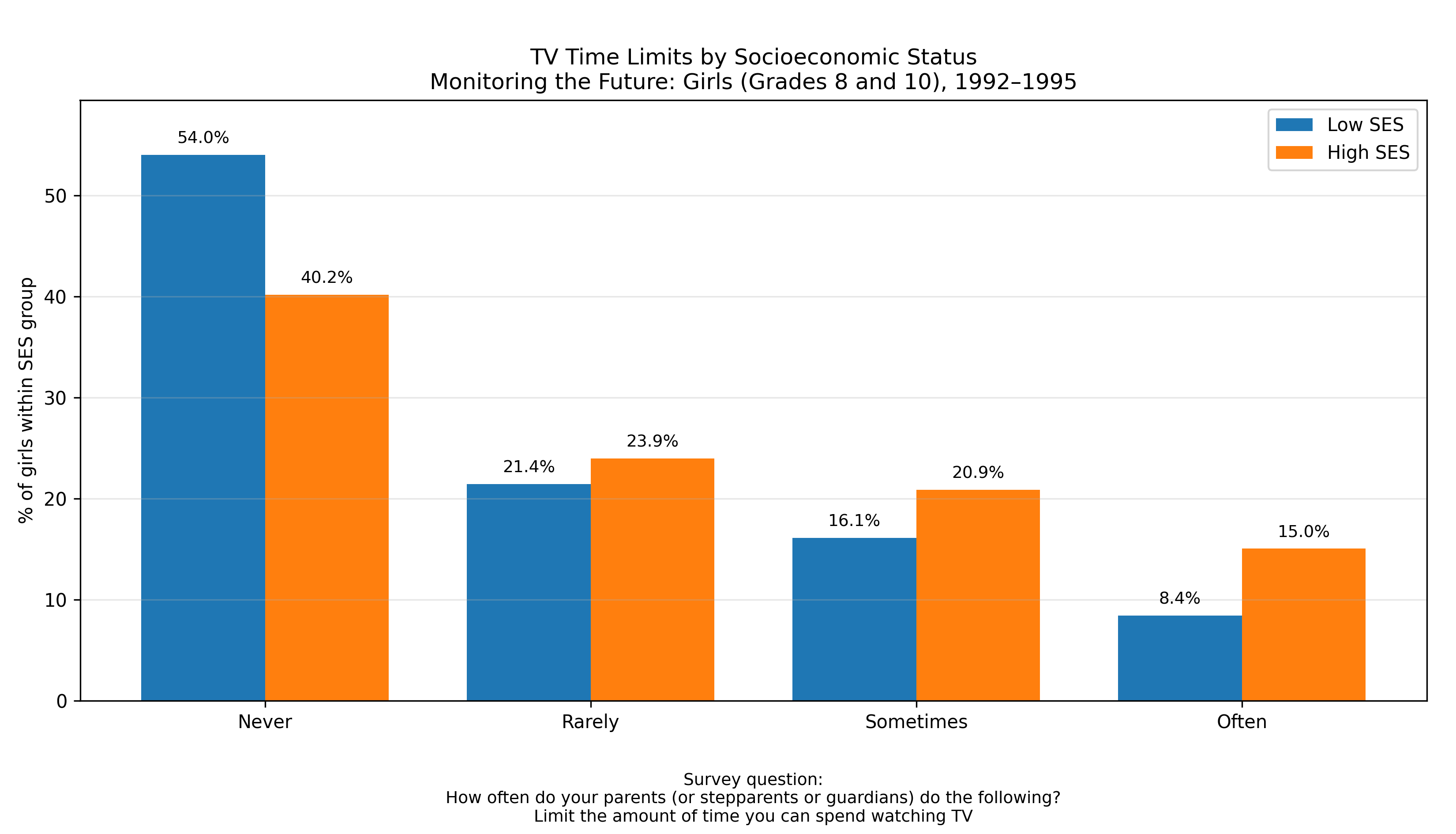
These differences reflect ordinary constraints. Households under greater financial pressure often find it more difficult to consistently monitor and enforce rules.
Who Has Reliable Parental Support
If the same household conditions that shape rule enforcement also shape relationships, differences should appear in the availability of parental communication.
Figure B shows responses to the question: if girls were having problems in their lives, would they talk them over with one or both parents?
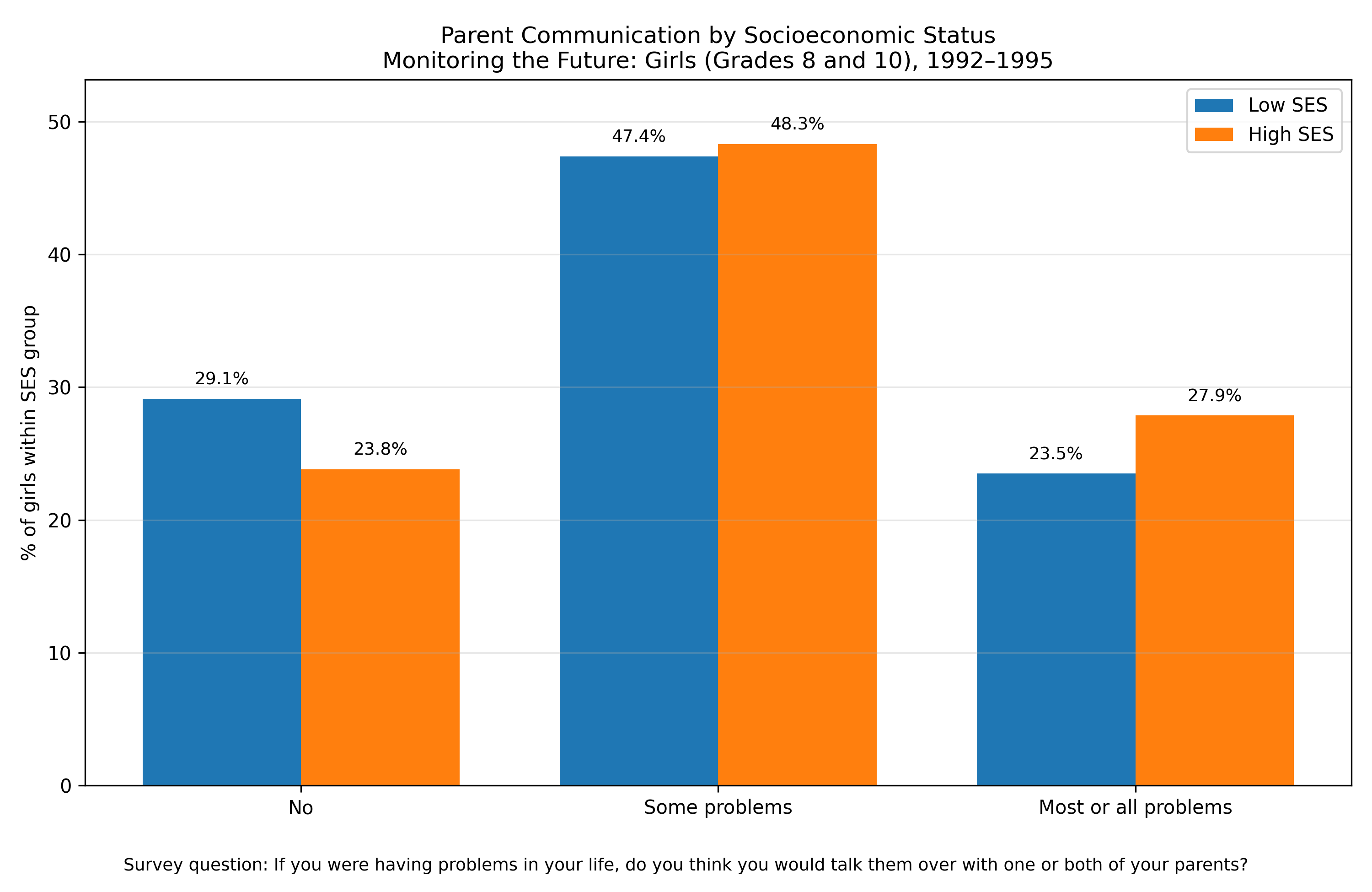
Lower socioeconomic girls are more likely to report that they would not talk with parents about their problems. Higher socioeconomic girls are more likely to report talking about most or all problems.
The middle category appears similar across groups. The difference appears at the edges. Some girls are fully outside the communication system, while others are securely inside it.
Communication reflects the same pressures that influence rule enforcement. Limits rely on relationships and do not operate independently of them.
Who Watches the Most Television
If access to support differs across households, these differences should appear in everyday behavior.
Figure C shows weekday television viewing by socioeconomic status.
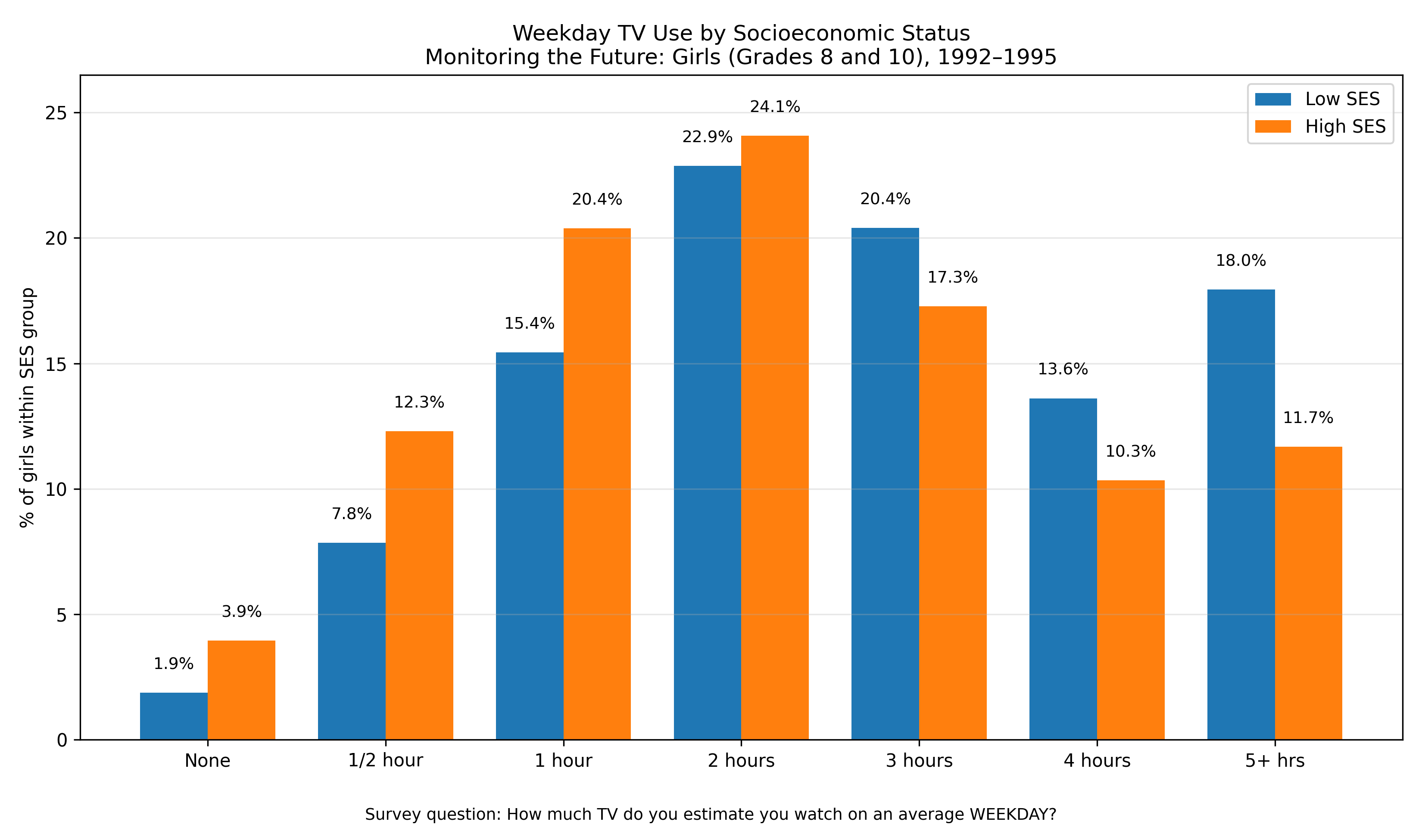
Girls from lower socioeconomic households appear more frequently in the highest viewing categories. Higher socioeconomic girls are more common in lower and moderate viewing ranges.
Television use in this context signals exposure to constraint. Higher use reflects fewer available alternatives during after-school hours.
Figure C-1 clarifies the pattern further by examining television use within parent-communication groups.
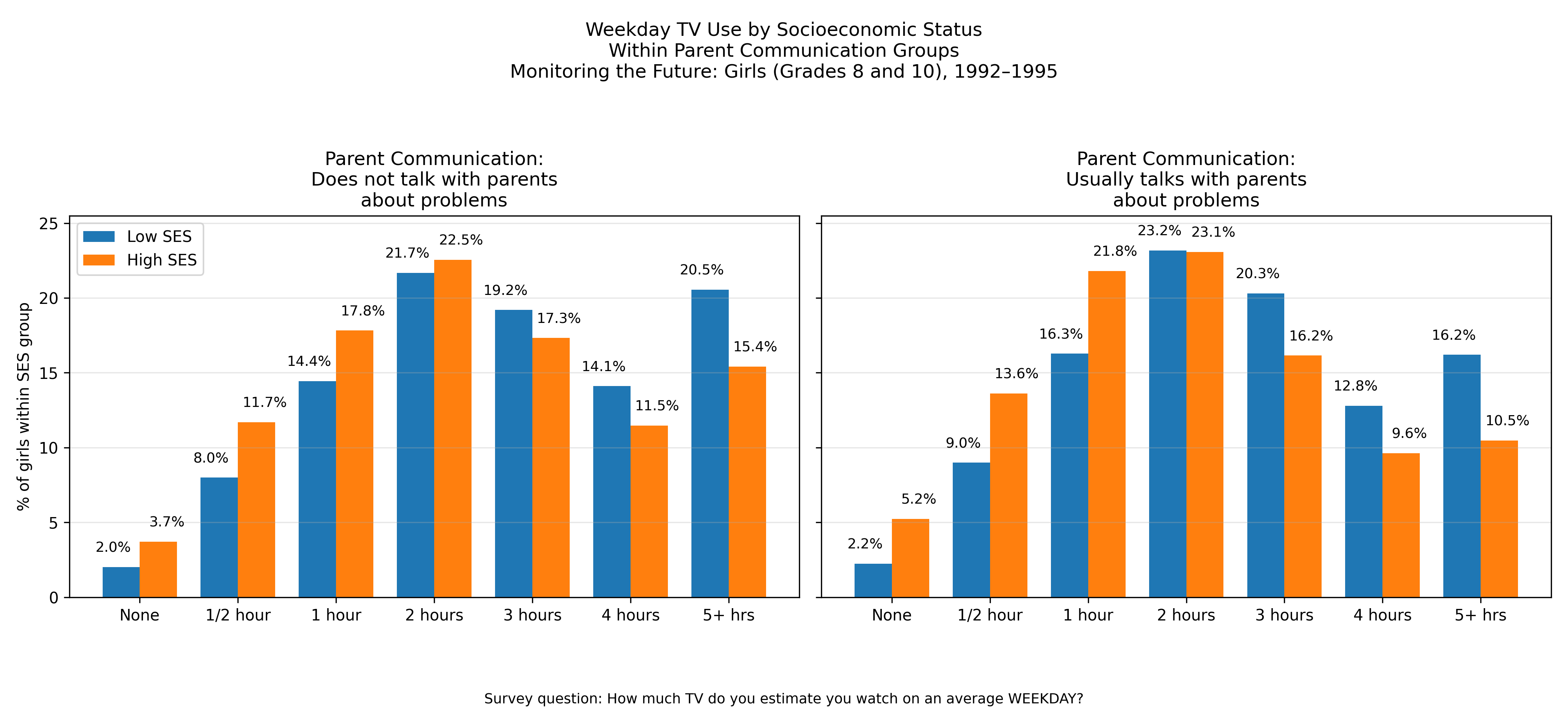
Where girls report talking with parents about problems, heavy television viewing declines within both socioeconomic groups. Where communication is absent, viewing shifts upward.
Communication does not erase socioeconomic differences, though it consistently reduces reliance on television within each group.
Why Limits Alone Fall Short
If television were the primary source of distress, restrictions should produce clear improvements in well-being.
Figure D compares happiness within the same parent-communication environments.
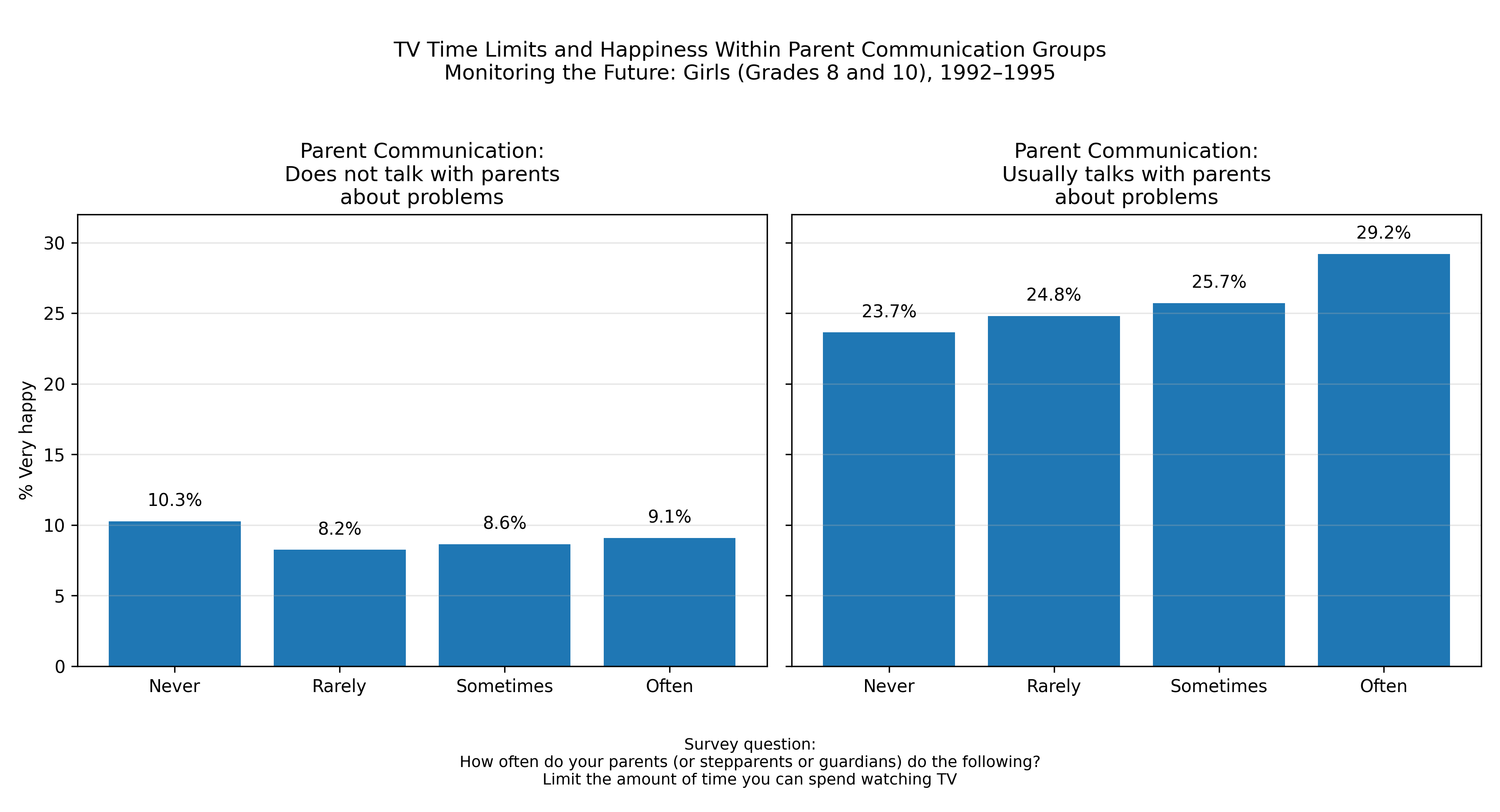
Among girls who do not talk with their parents about problems, happiness remains low regardless of how often television limits are imposed. Whether limits are never enforced or enforced frequently, outcomes change very little.
A modest association appears among girls who report talking with parents about most or all problems. Within that group, frequent limits correspond with somewhat higher happiness.
The size of this difference is small compared with the effect of communication itself.
Figure D-1 extends this comparison across socioeconomic status. The same conditional pattern appears for both lower and higher socioeconomic girls. Where communication is absent, limits show no meaningful relationship with happiness. Where communication is strong, frequent limits correspond with slightly higher happiness.
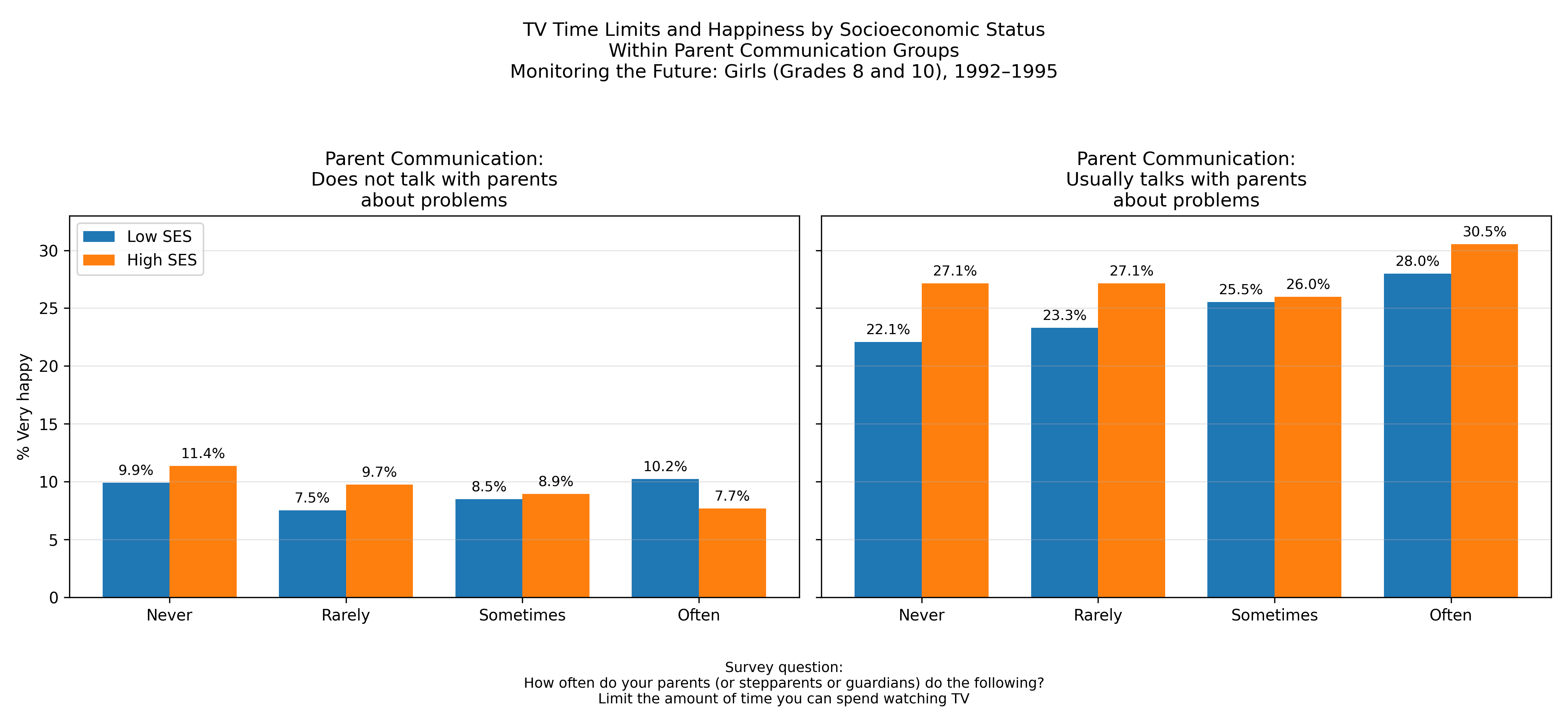
Limits therefore function within relational environments that already contain support and engagement.
Where those conditions are missing, limits do not replace them.
Why Relationship Outweighs Resources
If limits matter only under certain conditions, the next question concerns what most consistently predicts happiness.
Figure E shows a steep gradient by parent-child communication.
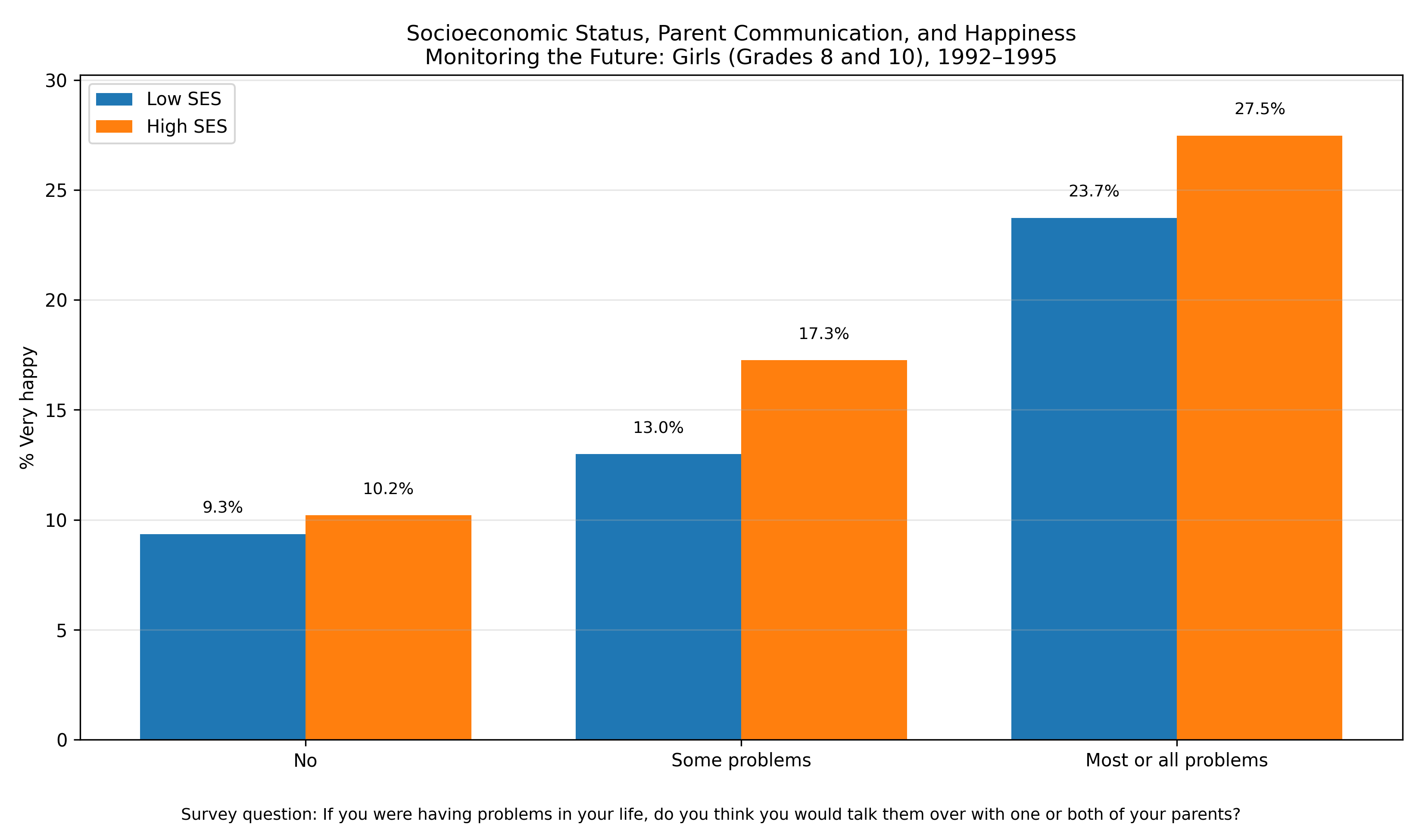
Girls who report no communication are rarely very happy. Those who report talking about some problems fare better. The largest gains appear among girls who report talking about most or all problems.
Higher socioeconomic girls report somewhat higher happiness overall. When communication is absent, this advantage becomes much smaller. When communication is strong, its effect is substantial for girls from both socioeconomic groups.
Material resources ease pressure and expand options. Sustained parental involvement remains the strongest predictor of well-being.
A Combined Statistical Test
A logistic regression model examined these relationships simultaneously.
The model predicts the probability that a girl reports being very happy using socioeconomic status, parent communication, television limits, and an interaction between limits and communication.
Parent-child communication dominates the model. Girls who report strong communication with their parents are more than twice as likely to report being very happy as those who report none. Television limits show little independent relationship with happiness and become modestly positive only when strong communication is present. Socioeconomic status also shows a modest independent association.2
The statistical model therefore mirrors the visual patterns.
The Compensatory-Use Model
The findings from the early 1990s align closely with the patterns observed in the modern smartphone era.
The same behavioral logic appears across two different technologies separated by decades.
Figure F illustrates the sequence underlying the compensatory-use model.
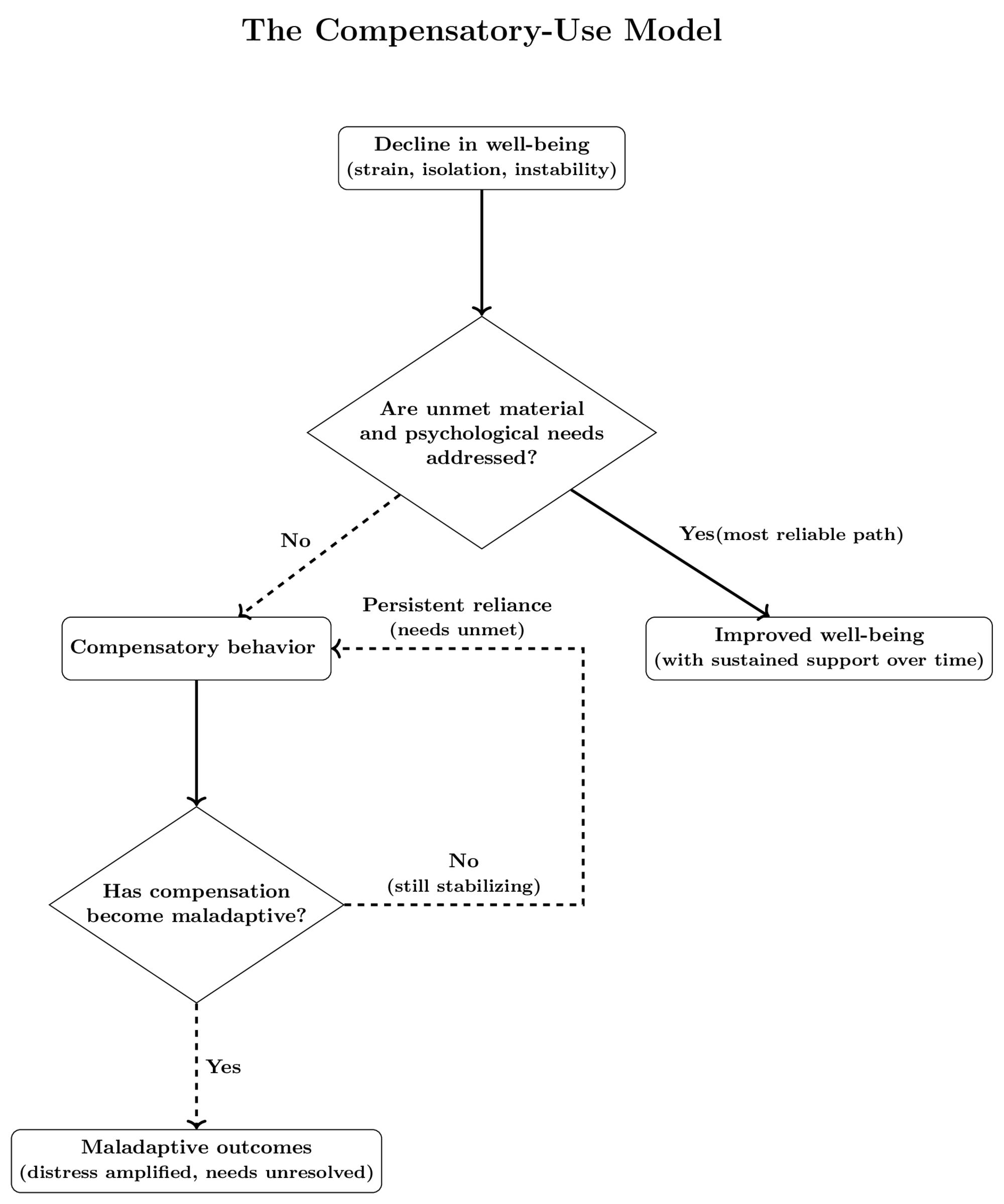
When material and psychological needs are addressed through consistent support, well-being improves over time.
When those needs remain unmet, young people often turn toward compensatory behaviors that provide stimulation or regulation. In the early 1990s, television often filled that role. In the present day, smartphones and social media frequently serve the same function.
Compensatory behaviors can stabilize emotional states in the short term. When reliance becomes persistent, these behaviors may grow maladaptive and amplify distress.
Strategies that focus only on the behavior treat the symptom instead of the cause.
A Pattern Across Generations
The debate over youth technology often assumes that each new medium introduces unprecedented psychological risks.
The historical evidence tells a different story. The patterns observed across decades point less to technology itself than to the family dynamics that shape how young people use it.
Television in the early 1990s displays the same structural relationships that appear in modern analyses of smartphone use. Limits show modest effects only where strong relationships already exist. Communication remains the strongest predictor of well-being.
Technologies change across generations. The underlying dynamics of youth development remain more stable.
When support is reliable, well-being improves and reliance on compensatory behaviors declines.
When support is absent, young people search for substitutes.
The most durable way to improve youth well-being begins upstream by addressing root causes.
Effective rules rest on a foundation of connection.
Socioeconomic status in this analysis is proxied by maternal education. Households in which a mother has a college degree are classified as higher socioeconomic status, and those without as lower socioeconomic status. The choice of this SES proxy and the focus on girls in grades 8 and 10 follow prior uses of these survey items in analyses of Monitoring the Future data, most notably by Jean Twenge.
Binary logistic regression using Monitoring the Future data for girls in grades 8 and 10 from 1992 to 1995 shows that parent–child communication has the largest association with reported happiness. Girls reporting strong communication are more than twice as likely to report being “very happy” (OR ≈ 2.3, 95% CI ≈ 2.0–2.6; d ≈ 0.45–0.50). Television limits show little independent association (OR ≈ 0.92), but become modestly positive when strong communication is present (interaction OR ≈ 1.17; d ≈ 0.09–0.12). Socioeconomic status shows a similar modest association (OR ≈ 1.17; d ≈ 0.09–0.12).
I find your model compelling. I definitely feel like the impact of screens on mental health is overstated. Anecdotes obviously make for inferior data, but my parents were very strict with my TV/computer and video game usage. I feel like that was detrimental to me socially because those limits set me outside of the monoculture. I wasn't a happy kid, and giving me more TV time wouldn't have changed that. The limits also caused issues because, as soon as I was on my own, I spent 90 percent of my time binge-watching TV and playing video games for a few years because those activities don't require work and do trigger lots of dopamine. Also, seeing all the other kids talk about the things they watched gave me the illusion that understanding everything in the social zeitgeist was the key to social success. Obviously, that isn't true. If I'd had fewer limits, I would have learned some valuable social lessons sooner. Yet, on the other hand, while I think the limits did nothing for my mental health, I came out of childhood with a direction and several useful skill sets because I had to fill my downtime with *something.*
As a parent, I've decided not to be so strict in terms of total screen time with my own kids, instead focusing on restricting the time of day (not right before sleep, not during meals) and the type, but I do wonder sometimes if allowing so much has harmed them. They still struggle to socialize and find their place, mostly because it's a rough world out there. I feel like screen use can be a crutch for fixing real problems in a person's life, but since the real problems are often society-wide and an individual is powerless to fix them, I'm not sure what I should be doing. In some ways, I feel like smartphone use is the new opiate for the masses. If other kids weren't inside on their TVs/Computers/Devices, my kids would have a better chance of being a part of a pack of friends roaming the neighborhood. If other adults weren't always on their phones, I'd have a better chance of finding a friend on the bus or wherever. But our neighborhood post-pandemic is a ghost town for adults and kids alike. We have third spaces, but no one uses them, because sitting at home on your phone is easier. I can't fix that. I'm glad my kids seem to gravitate to edu-tainment instead of say, unboxing videos, but it's still hardly an optimal use of their time. God knows, I fill myself with so much junk, it's hard to put regulations on them without being a hypocrite.